Showing posts with label Palestin. Show all posts

Wednesday, 25 November 2015

Once in Time when Palestinian Farmers Harvesting Olive This Year

By Diana Qatamesh, the West Bank Programme Policy Officer.

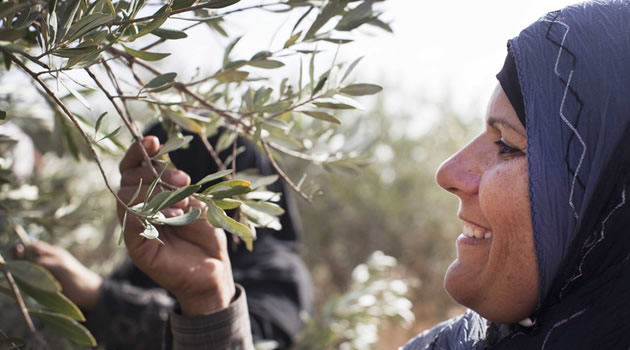
TEMPO.CO, Jakarta - The annual olive harvest, which finishes this week, is one of the most important events of the year for Palestinian farmers. It brings communities together and provides an income for around 80,000 families.
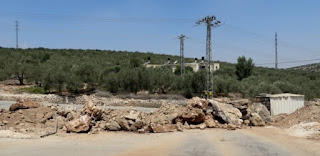


Yet olive farmers in the West Bank face enormous challenges. Their access to land, water and markets is often limited by Israeli settlements, checkpoints and access restrictions, all aspects of the Israeli occupation. But despite these challenges, olive farming has huge economic potential. The olive oil industry provides up to 14 percent of Palestinian agricultural income, and agriculture accounts for nearly 25 percent of GDP.


I went to Deir Istiya to meet some of the olive farmers there. Deir Istiya is a small village in the hills surrounding Salift in the central West Bank. It is famous for its olive groves.

Deir Istiya has a total area of 34,000 dunums. Approximately 6,000 dunums were designated as Area ‘B’ under the Oslo agreement in 1993. This means they are under Palestinian civil control, but the Israeli military controls security. The rest of the land, constituting 28,000 dunums, has been designated as Area C. This means that although it is in the West Bank, the government of Israel retains control of all aspects, including planning and security. In Deir Istiya, 83 percent of the total area is under Israeli government control, and the village is surrounded by seven Israeli settlements.


When we first reach the area we meet with Yaseen Abu Hijleh. He is 88 years old and one of the founders of the olive oil cooperative in Deir Istiya, started in 1976. Abu Hijleh told me about the olive press that the cooperative first bought. “Due to a lack of water we were only able to buy a half automatic press, which uses a lot less water than a fully automatic one. At the time it sounded amazing. We were the first village in Salfit area to possess an olive press.”
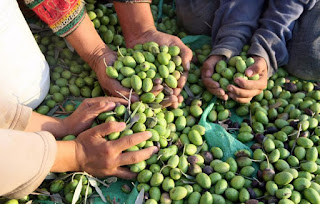


The cooperative has 150 members now and it has transformed the half automatic press to a fully automatic one.Mustafa Kokash, an olive farmer from Deir Istyia, shows me around the press. “For the fully automated press we have to buy water from Israel – each harvest it costs us about NIS6000,” he tells me. Shortage of water is a huge problem for Palestinian farmers, particularly in Israeli-controlled Area C, where Palestinians are rarely allowed to build new wells, pipes or cisterns. Between 1988 and 2013, Oxfam’s partner, Bimkom, reported that 94 percent of all Palestinian applications for construction in Area C of the West Bank were rejected.
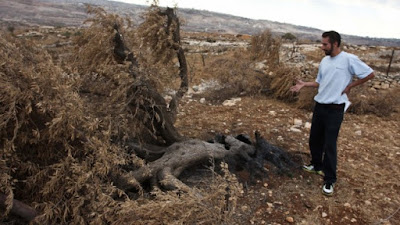


Most of the farmers here have lost trees due to Israeli settlers. They have been burnt, uprooted or cut down – actions for which there is rarely accountability in Israeli courts. Since 2010 more than 60,000 olive trees have been lost in the West Bank. Farmers also face restrictions on their movements, especially in land near the settlements. To do anything to their trees they have to get a permit from the Israeli authorities.

Oxfam partner Yesh Din reports that 95 percent of crimes reported by Palestinians to Israeli police are closed, unresolved.

Mustafa told me: “Five months ago Israeli settlers cut down and burned 350 olive trees from my land near one of the settlements. These olive trees were three years old and were supposed to start producing olives next year. Buying them cost me NIS4500. If settlers did not uproot them and they reached their producing age they would have produced 150 kg of olive oil a year.”
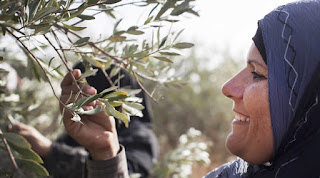


In 2007 Oxfam started working with the Deir Istiya farmers’ cooperative. Ayoub Abu Hijleh, one of the programme officers for Oxfam, said: “we at Oxfam wanted to make the situation for olive farmers much better than it was at that time. Farmers here face their trees being uprooted and huge restrictions on when they could care for their trees.”

Oxfam and local partners run the ‘From Grove to Market’ programme, funded by the Swiss Government, which helps Palestinian farmers improve the quality and quantity of their oil and reach local and international markets. Oxfam gave the farmers training on how to take care of the olive trees, and introduced them to the best techniques in order to produce high quality olive oil and to increase the amount produced.

Oxfam also made it possible for Palestinian farmers to obtain internationally recognised organic olive oil certification. This opened up new markets in countries like the UK and France, helped them compete globally, and it increased their profits. At the moment there are 17 farmers in Deir Istiya in the process of getting their organic certification.
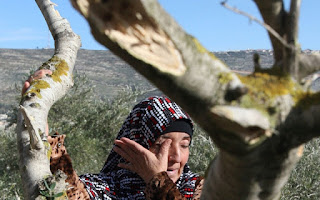


I met another farmer in Deir Istaya, Azzam Salman. Azzam, who is 41 years old, owns land near one of the settlements. He was given four days by the Israeli authorities to harvest it. “It is 20 dunums of land, and has almost 100 olive trees. It would need 15 days or more to harvest,” said Azzam. “In the early 1990’s, when these olive trees were cared for, they would produce 500kg of olive oil a year. Now the same trees produce only 40kg of olive oil. I can’t get to them to plough them or prune them.”

Azzam knows that the money he gets from the 40kg of olive oil is not much, but he still goes to harvest the trees to make sure he retains ownership of the land.
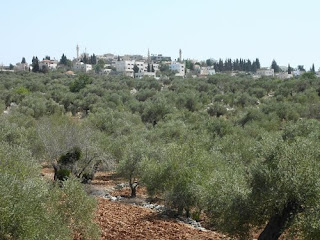


As I was leaving the village I couldn’t help but reflect on the immense changes these farmers have witnessed in their village. In one lifetime Deir Istiya has been surrounded by settlements, land has been confiscated and countless olive trees have been uprooted. I hope that the farmers here can one day harvest, prune and plough their trees without waiting for Israeli permits.

[Source: TEMPO.CO]

Monday, 16 November 2015

Soldiers, Paramilitary Settlers, Attack Family Picking Olives In Their Own Orchard

On Sunday, Israeli soldiers and paramilitary guards of an illegal Israeli colony invaded a Palestinian olive orchard in Beit Ummar town, north of the southern West Bank city of Hebron, attacked the family and forcibly removed them from their own land.

Media spokesperson of the Popular Committee against the Wall and Settlements in Beit Ummar town, Mohammad Ayyad Awad, said paramilitary settlers of the Beit Ayin illegal colony, built on Palestinian lands, and Israeli soldiers, invaded an olive orchard before attacking and removing Hammad Abdul-Hamid Sleibi and his family from their land.


The orchard is located in Wad Abu ar-Reesh, north of Beit Ummar, close to the illegal colony that was built on privately-owned Palestinian lands.

The security guards attacked the Palestinians and chased them while threatening to shoot them with their automatic rifles, while the soldiers fired gas bombs and concussion grenades on the family, forcing them out of their own olive orchard.

On Sunday evening, eight Palestinians, including a cameraman working for France Press, have been injured, by Israeli army fire, after several military vehicles invaded the northern West Bank city of Qalqilia.

Also on Sunday, Palestinian medical sources reported Sunday that a 2-year-old toddler was injured after an Israeli military vehicle struck him in Bir Niabala town, in the Central West Bank district of Ramallah, and that a woman was injured in a similar incident in Ramallah.

In addition, six residents were injured by Israeli army fire after the soldiers invaded al-Baloa’ area in the al-Biereh city, leading to clashes with scores of local youths.

[Soource: IMEMC]

Friday, 13 November 2015

Destroying a symbol of life

By César Chelala


During the last few years, Palestinian olive trees, a universal symbol of life and peace, have been systematically destroyed by Israeli settlers. “It has reached a crescendo. What might look like ad hoc violence is actually a tool the settlers are using to push back Palestinian farmers from their own land,” a spokeswoman for Yesh Din, an Israeli human rights organisation monitoring incidents in the West Bank, previously stated.


The tree and its oil have a special significance throughout the Middle East. The olive tree is an essential aspect of Palestinian culture, heritage and identity, and has been mentioned in the Bible, the Qur’an, and the Torah. Many families depend on the olive trees for their livelihood.


Olive oil is a key product of the Palestinian national economy, and olive production is the main product in terms of total agricultural production, making up 25% of the total agricultural production in the West Bank. Palestinians plant around 10,000 new olive trees in the West Bank every year. Most of the new plants are from the oil-producing variety. Olive oil is the second major export item in Palestine.

For the last 40 years, over 1m olive trees and hundreds of thousands of fruit trees have been destroyed in Palestinian lands. The Israel Defence Forces have been accused of uprooting olive trees to facilitate the building of settlements, expand roads and build infrastructure. The uprooting of centuries-old olive trees has caused tremendous losses to farmers and their families. At the same time, restrictions to harvesting have come through curfews, security closures and attacks by settlers.


The uprooting of olive trees by the Israel Defence Forces and by settlers are done to protect the settlers, since they are supposedly used to protect gunmen or stone throwers. “The tree removals are for the safety of settlers… No one should tell me that an olive tree is more important than a human life,” declared an IDF army commander, Colonel Eitan Abrahams.

“As a result of the attacks on farmers by the IDF and by settlers, the farmers can’t get to their lands and work them. The settlers chase the farmers, shoot in the air, threaten their lives, confiscate their ID cards and damage the crops,” stated B’Tselem, an Israeli human rights organisation.

Practically not one of the complaints filed during the past several years on damage to Palestinians trees in the West Bank resulted in an indictment. The toll includes thousands of trees from several areas from Susya in the southern Hebron Hills to Salem in northern Samaria.


Last April, Israeli settlers from the Immanuel settlement uprooted some 450 olive trees and saplings from lands in Deir Istiya, northern Salfit. This followed the uprooting earlier of 120 olive trees in Wadi Qana. Since 1967 some 800,000 olive trees have been uprooted by Israeli forces and settlers in the occupied West Bank, according to research from the Palestinian Authority and the Applied Research Institute Jerusalem. This has threatened the livelihood of 80,000 families.

In a review he wrote on this issue, Atyaf Alwazir, a young Muslim American, stated that the uprooting of trees from Palestinian lands violates the Paris Protocols, The Hague and Geneva Conventions and the Covenant on Economics, Social and Cultural Rights.

According to Sonja Karkar, founder of Women for Palestine in Melbourne, Australia, uprooting olive trees is contrary to the Halakha (the collective body of Jewish religious law) principle whose origin is found in the Torah: “Even if you are at war with a city… you must not destroy its trees.”

To some Jewish activists’ credit, however, many of them are collaborating in the planting of new olive trees, to replace some of those uprooted by the Israeli settlers. On several occasions Rabbis for Human Rights donated saplings to Palestinian communities affected by the uprooting.


What do settlers actually want? To continue destroying Palestinians’ livelihood with impunity? To create a barren land, unfit for trees and people? To intimidate, terrorise and punish those who resist this tactic? Perhaps they should be reminded of A. E. Housman’s verses:

Give me a land of boughs in leaf,
A land of trees that stand;
Where trees are fallen there is grief;
I love no leafless land.

Dr. César Chelala is an award-winning writer on human rights and foreign policy issues.

[Source: Daily News Egypt]

Friday, 11 January 2013

Settlers, Palestinians clash after olive tree attack

Israeli soldiers on Saturday were trying to break up clashes between Palestinians and Jewish settlers in the northern West Bank town of Qusra.


Palestinian protestors throw stones at Israeli soldiers in the northern village of Qusra. Israeli soldiers on Saturday were trying to break up clashes between Palestinians and Jewish settlers in the northern West Bank town of Qusra.


Palestinian security sources and eyewitnesses said settlers used the cover of fog to approach the town south of Nablus with the aim of uprooting dozens of olive saplings, but were confronted by farmers who threw stones at them.

Settlers from the nearby Esh Kodesh outpost and Qusra residents also clashed and threw stones at each other on Tuesday, when the Palestinians blamed the settlers for uprooting and damaging olive trees.

The Palestinians said saplings uprooted on Saturday were planted following Tuesday's incident.

A spokeswoman for the army confirmed that "there is a confrontation near Esh Kodesh, including mutual stone-throwing."

"Soldiers arrived at the scene and are currently responding with riot dispersal means," she added, noting there were reports of a lightly wounded Israeli civilian. The Palestinians said some villagers were injured by tear gas.

The Esh Kodesh settlers had said on Tuesday they would block Palestinians from working in fields near the outpost. Both sides claim ownership of the land.

[Source: AFP via France 24]

Related:

Sunday, 6 January 2013

Hundreds of Palestinian olive trees vandalized by Israeli settlers

More than 870 trees were vandalized in the first week of the harvest in the West Bank.

By Stacey Leasca

More than 870 trees were vandalized in the first week of the harvest in the West Bank, according to a report by the United Nations.

The vandals behind the attacks are reportedly Israeli settlers.


A Palestinian woman shows the damage of one of her old roman olive trees in the village of Qarut, that was allegedly set on fire by Israeli settlers from the neighbouring Jewish settlement of Eli, near the West Bank town of Nablus, on October 13, 2012. AFP/Getty Images


“These acts are reprehensible and I call on the Government of Israel to bring those responsible to justice,” the United Nations Special Coordinator for the Middle East Peace Process, Robert Serry, said in a statement. “Israel must live up to its commitments under international law to protect Palestinians and their property in the occupied territory so that the olive harvest – a crucial component of Palestinian livelihoods and the Palestinian economy – can proceed unhindered and in peace."

The Guardian also noted that settlers may launching attacks under the protection of the Israeli military according to Hanan Ashrawi, a member of the Palestine Liberation Organization's executive committee.

Yesh Din, Israeli human rights group, says it has logged 35 attacks targeting olive trees, grapevines and other fruit trees between September 2011 and July 2012, according to the Middle East Monitor. The group also said that in 99 percent of cases the police have closed their investigations for lack of evidence.

In a statement the group said, "The police failure to enforce the law and protect Palestinian property encourages the criminals who go unpunished and are not deterred from repeating their actions."

But Israeli police spokesperson Micky Rosenfeld combated these allegations, telling AFP that the report's results are "inaccurate and out of date", adding that "the police have stepped up activity, particularly over the past few weeks, in dealing with the incidents which have been taking place."

Since the beginning of this year, 7,180 Palestinian-owned trees have been vandalized by settlers, said the Guardian noting a memo from the UN's office for the co-ordination of humanitarian affairs. Last year about 10,000 trees were vandalized or uprooted.

[Source: GlobalPost]

Wednesday, 2 January 2013

Gethsemane: An olive grove's place in local imagination

It is assumed that all ancient anointing was done with oil of the olive fruit, then as now a precious fluid.

By Noga Tarnopolsky

GARDEN OF GETHSEMANE, Jerusalem — After the last supper, Jesus walked with his disciples to Gethsemane, at the base of the Mount of Olives, where scholars believe he spent some time in the olive grove and contemplated his impending arrest among the tombs which were vast and old even then.


"Gethsemane" — in Hebrew, "Gad Shmanim" — means "oil press."

In the back garden of the Church of all Nations, the olive trees and the tombs are still there.

"Maybe Jesus really walked among these trees," says Yaacov Shkolnik, a forester and head of the Jewish National Fund's Ancient Tree Task Force, which is tasked with identifying trees and estimating their age and assessing their overall health.

The trees at Gethsemane have grown hollow and wide and pose special difficulties for professionals. At best, estimations of their age rely on tiny splinters remaining from the ancient wood. According to the National Research Council of Italy, which examined the trees, they are at least a thousand years old.

Workmen pruning the ancient, craggy trees behind the church are completely oblivious to eBay or the possible resale value of the spindly branches and silvery ovaloid leaves they toss by the side of the street, near an idling garbage truck.

Whatever that potential value, by arboreal standards the olive trees that may have offered succor to an anxious Jesus are relatively young. The oldest known tree in the world is a pine nicknamed Methuselah, estimated to be 4,7000 years old, living in California's White Mountains.

Olives, their oil, and the trees they grow on hold an oversized place in local imagination.


Picture by The Muslim Times


It is assumed that all ancient anointing was done with oil of the olive fruit, then as now a precious fluid. Today, the churches of Jerusalem, Bethlehem and Nazareth use local oil, often grown and pressed on church premises.

In Nazareth, the harvest was completed about a month ago, each family marinating and pressing by its own closely-held tradition. Christmas tables include small plates of the year's harvest.

In villages further to the north, pressing olive oil is a venerated Christmas Day tradition, bringing far-flung family members together around the presses for a yearly yuletide event no one wants to miss.

It is impossible to describe the intoxicating scent that emanates as small green and purple olives pour into a huge stone saucer the size of a hot tub and are slowly crushed by a massive granite wheel. It is almost like watching a gemstone being made.

The glistening, perfumed mash is then transported to multilayered electric presses where the oil is pushed out of the pits and the skins.

The residue, back oily organic disks, are used in the place of wood, for burning. The oil, for everything else.


The Galilee town of Nazareth in northern Israel, seen between the branches of an olive tree.(David Silverman/AFP/Getty Images)

The Khalaf family, of a tiny village called Muran, invested in a state-of-the-art hydraulic olive press from Italy, which regulates the pressure and speed of pressing, and thus the acidity and viscosity of the oil. Same rocks as in ancient times, but now shaped and moved by electricity and calculations, not the paces of a donkey.

More than any Hollywood movie, this activity seems to melt Biblical times with our own reliance on machinery.

Children stand around and stick their fingers in the dribbles of golden elixir as it begins to pour from the rounded disks.

That's in northern Israel.

Down south, nearly half of all agricultural lands in the West Bank are planted with 8 million olive trees. Extremist elements among Israeli settlers have made an annual rite of disrupting the olive harvest there, often causing permanent harm to the Palestinian groves and damaging the local economy.

"It is all part of a wider philosophy," says Israeli human rights activist Amiel Vardi, who has protected Palestinian fields from settler attacks, "in which these settlers want to disrupt and embitter the lives of the West Bank Palestinians in the hope that they will 'self-deport' to the large cities, leaving their lands empty."

Vardi says that Palestinians file less and less complaints with the police, "because they feel it’s a meaningless task, just part of saving face by the authorities."

OCHA, the UN's Office for the Coordination of Humanitarian Affairs, says in its latest report that Israeli soldiers deployed to protect Palestinians heading to their groves on harvest days have reduced some of the physical attacks that were more common in recent years, but do nothing to protect the groves from damage inflicted at other times of the year.

[Source: Global Post]

Thursday, 20 December 2012

Palestinian Olive Harvest Turns Bitter As Economy Sputters

by Anthony Kuhn


Palestinian women harvest olive trees near the occupied West Bank village of Deir Samet near the town of Hebron. Hazem Bader/AFP/Getty Images


Across the West Bank, olive harvesting season is drawing to a close once again. But this year, the usually joyous occasion has become grimly purposeful because the Palestinian economy, according to some economists, is being held hostage to politics, and is on the verge of collapse.

In the West Bank village of Deir Ibzie, Amal Karajeh and her husband, Basem, comb through the leaves and branches of an olive tree in their front yard.

The plump green olives rain down on the ground, where they're collected in plastic sheets and buckets. Both of the Karajehs have taken time off from their jobs to harvest the olives. She's employed by the Palestinian Authority's statistics bureau; he works for a local telecommunications company.

Amal Karajeh says the government is behind in paying her salary.

"We often eat meat once a month, instead of once a week," she complains. "We cook every other day. We try to lower our standard of living. In order to get by, we borrow money. So when the salary finally comes, it's all owed to other people."

Amal Karajeh says Palestinians are under financial strain, and West Bank society is tense.

"If the government let them, people would explode in its face," she says. "But people are restraining themselves, because of the land and because of the olives. Before, employees just waited for their salaries. That's the wrong strategy. They must go back to farming the land. They must depend on themselves."

Her husband, Basem, explains that most of the family's more than 100 olive trees are next to the Israeli settlement of Dolev. He says that since the second Palestinian uprising in 2000, the Israelis have only allowed him to harvest and tend to his olive trees once a year. He says that if he watered and pruned his trees more often, he could double the amount of olives he harvests from them. But, he says, it's not worth the risk of being attacked or arrested by Israelis. Recently, there have been reports of arson and tree uprooting by Israeli settlers, unnerving many Palestinian olive farmers.

"Ten or 15 years ago, before the coming of the Palestinian Authority," says Basem, "during the Israeli period, life was easier. Now it's getting extremely difficult. This problem will never be solved," he says, shaking his head.

Khalil Shiha is director general of the Palestinian Agricultural Development Association, which helps Palestinian farmers. He says the olive harvest serves not only as an economic safety net; it also symbolizes his people's ancient ties to the land.

The "olive tree is a symbolic tree for peace and for freedom," he explains. "This is why Palestinians insist on cultivating the olive trees and trying to expand the cultivating of these trees everywhere."

Shiha quotes an old Palestinian saying that as long as a family has wheat and olives, it won't suffer poverty or hunger. To poor Palestinians who spend about half of their money on food, olives that are made into pickles and cooking oil remain essential to survival.

But olive farming and agriculture in general contribute only a tiny fraction of the West Bank economy. Unemployment in the West Bank is around 20 percent, and the Palestinian Authority, one of the area's biggest employers, is running an annual budget deficit of around $1 billion.

Until recently, the Palestinian Authority covered this shortfall with foreign aid and local bank loans. But Tel Aviv University economist Yitzhak Gal says that no bank will loan to the Palestinian Authority any more, and foreign aid has dropped by half since mid-2010, because donors have lost hope of progress in the Israeli-Palestinian peace process.

"They're fed up of pouring more and more and more money, and no hope," Gal says. "Because if Israel is not ready to change this set of impediments, there is no chance for sustainable economic development in Palestine, so they will be dependent on external aid forever."

One of the biggest problems is that Israeli policy forces West Bank Palestinians to import food, fuel and other necessities from Israel at Israeli prices. Israel's per capita GDP of more than $30,000 per year is about 10 times that of the West Bank. Gal says that Palestine ranks among the region's poorest economies.

"Taking into consideration real cost of living," he says, Palestine's economy "ranks much below Jordan, much below Egypt, more or less like Yemen, Sudan, these kind of countries."

But, Gal says, the West Bank's links with the Israeli economy are in some ways a great advantage. The Israeli shekel, for example, is far more stable than any currency the Palestinian Authority could issue.

The problem, he says, is the West Bank's dependence on Israel. For example, the 1993 Oslo Accords authorize Israel to collect sales taxes and duties on imports into Palestine, and then give the revenue to the Palestinian Authority. Gal says that Israel could change this very easily if it wanted to. As an example, he cites the Gaza Strip, which imports more reasonably priced goods from Egypt (or has them smuggled in), instead of from Israel.

But the current arrangement gives Israel political leverage that is hard to give up. On Sunday, Israeli said it would withhold $100 million of those revenues, apparently to punish the Palestinian Authority for successfully upgrading its status at the UN last week. It's this sort of punishment, Gal worries, that could be the final straw for the tottering Palestinian economy.

Because fertilizer and water have to be imported from Israel, it is difficult for Palestinian olive oil exports to compete with Italian, Greek and Spanish exports, although there are a few groups that do, like Canaan Fair Trade.

Under these dire circumstances, the Karajeh family says this year's olive harvest gives them a special sense of freedom and accomplishment. They will take the olives to be pressed into oil. They estimate that this year's crop will yield around 25 large cans of oil, enough for their extended family to cook with for a year, and even a little extra to sell to friends and neighbors.

[Source: The Salt]

Wednesday, 19 December 2012

Vandalising the olive groves

Israeli settlers are routinely destroying Palestinian olive groves and ruining livelihoods in the occupied territories, writes Saleh Al-Naami


Palestinian clinging to their trademark life source: the Olive Tree


Mohamed Kamel, 48, urged his wife and children to go to bed early in order to get up at dawn. It was time for the family to head out to their olive plantation near the village of Karyut south of Nablus in the occupied Palestinian territories.

The family woke up early and having performed the dawn prayers drove off to the olive farm. However, as the car approached the farm, Kamel slammed on the brakes so hard his head almost hit the steering wheel.

What made him stop so suddenly was the scene of havoc that greeted him. No olive tree was left standing on the farm, and all of them were either cut down or uprooted. The entire farm was a jumble of twisted roots and branches.

The family contemplated the scene in silence for a moment. Then the children started to cry, having realised the extent of the damage. The farm, which had provided the family with much of its livelihood, was no more.

For the members of this family, the identity of the culprits was not a matter for debate, as the family knew that the inhabitants of Tafouh, an Israeli settlement situated 200 yards away, were the ones who had done it.

The settlement is known to belong to Kahane Chai, a Jewish religious organisation which says that the Palestinians in the occupied territories should be placed in trucks and thrown out over the borders.

The members of Kamel’s family had no option but to collect whatever olives they could find in the branches of the dead trees and then leave.

According to Kamel, the Israeli settlers are following such tactics in order to drive him and other Palestinian farmers off their land. The nearby settlements are interested in buying the land, and this is their way of making their offer more attractive.

Kamel says that it will take years for the trees to grow back, but he is not selling. “Despite everything they do, we will not back down. We will hold on to our land until our blood runs on its soil,” he said.

Bilal Eid, 48, who lives in Burin, a village southwest of Nablus, paints a grim picture of life in the village, noting the attacks that the farmers often suffer during the olive harvest.

Over the past five years, he says, nearly 16,000 assaults have been mounted by Israeli settlers on his village. Thousands of olive trees have been uprooted, and many families have been shocked to see olive trees uprooted on their farms. Eid says that it is clear that the uprooting of the olive trees is meant to drive the Palestinian farmers away.

“Settlers from the nearby settlement of Brakha have distributed leaflets saying that the land of Burin belongs to the Jews and that unless the Palestinian families leave the village in the next five years the settlers will drive them away by force,” Eid says.

This is not an empty threat, since the Israeli settlers have already taken control of some 14,000 dunums (14 square kilometres) of the village’s total land of 33,000 dunums (33 square kilometres).

The settlers also attack the houses closest to the olive farms. When Eid and his family were away a few months ago, 100 settlers looted and destroyed his home.
Eid is frustrated at the inability of the Palestinian Authority (PA) to bring the attacks to an end. The most that it has done, he says, has been to file a complaint with the Israeli army, known for its bias towards the settlers.

In fact, the Israeli army prevented Eid from rebuilding his house, meaning that he now lives at a considerable distance from his olive farm.

Eid also says that he has far fewer trees on his farm than he did before. The Israeli settlers kill the mules and donkeys that Palestinian farmers use to transport their harvest, he says, also killing the cattle that graze near the farms.
Eid says that the settlers have also poisoned some of the wells the Palestinians rely on for drinking water.

A week ago, dozens of settlers attacked Palestinian farmers collecting olives near the village of Orif on the West Bank, wounding several.

Ghassan Duglas, an activist following up the attacks by the settlers, says that they routinely pelt Palestinian farmers with rocks and that the Israeli army acts to protect the settlers, not their victims.

In some cases, the settlers have shot at farmers collecting olives. In Al-Zahriya in the south of the West Bank, several farmers were the victims of gun-shot wounds two weeks ago when settlers shot at them while they were collecting their olives.
In some cases, the settlers have stolen the harvest. Khadra Abul-Rab, a farmer from Jenin, says that when she went last week with members of her family to their farm, they saw dozens of settlers collecting their olives.

“I screamed at them to stop stealing the harvest. But they threatened to kill us and continued to collect the olives. I had no option but to leave the farm, as I was afraid for myself and my family. We didn’t go back until they left,” Khadra says.
When the settlers learned that Khadra had come back to collect the remaining olives on her farm, they uprooted all the trees.


In some instances, the settlers resort to arson. Two weeks ago, the inhabitants of Hawara, a village in the north of the West Bank, saw columns of smoke rising from olive trees near their village.

The fire raged for five hours because the inhabitants of the nearby Yitzhar settlement had blocked the roads to prevent fire engines from arriving at the scene.
Palestinian farmers in the central and northern parts of the West Bank say that local councils in Jewish settlements even often bring hundreds of wild boar and release them in the heart of Palestinian farms in order to ruin the crops.
Itmar Ben Gaffer, a young settler, boasted to Israeli television recently that he was the one who had come up with the idea of using wild boar to wreck Palestinian farms.

Large swathes of Palestinian farmland have been caught behind the annexation wall that Israel built across the heart of the West Bank in 2005. Entire villages have become inaccessible to farmers, unless they get an Israeli army permit to visit their land, which is not always easy.

In Al-Tiba, a village just west of Jenin, farmer Ahmed Mahajna says that 3,000 dunums (three square kilometres) of his olive groves are now out of reach, as the Israeli occupying authorities often refuse farmers permits to go onto their own land.
According to the UN Office for the Coordination of Humanitarian Affairs (OCHA), Israeli settlers have destroyed nearly 7,500 olive trees since the beginning of this year.

Nearly half of the Palestinian agricultural land is planted with olive trees, in all about eight million of them generating 14 per cent of income in the Palestinian territories. The olive industry is said to support nearly 80,000 Palestinian families.

OCHA officials say that the Palestinians have filed 162 lawsuits with Israeli courts, all involving attacks by settlers on farmers and their land. However, of these lawsuits, only one case has been investigated and brought to trial.
Jewish clerics have been issuing religious edicts claiming that attacks on the Palestinians are in keeping with the Torah.

Rabbi Shlomo Melmed, one of the most influential religious figures in Israel, has said that the settlers are entitled to steal and pillage Palestinian olive crops.
Melmed has led students from the religious institute in the Yitzhar settlement in the north of the West Bank on a mission to pillage the Palestinian olive crops, and this was aired on Israeli television.

Rabbi Dov Lior, head of the Council of Rabbis in the Israeli settlements, has also told settlers to uproot and burn Palestinian trees.
The situation in Gaza, an area in which there are no settlers or Israeli army, is no better.

Most of the agricultural land in Gaza is situated close to the border line with Israel. The border area is currently being bombarded by the Israeli army, on the pretext that Palestinian fighters are using it to fire rockets at Jewish settlements.
Farmers, desperate to collect their harvest, have to take great risks in order to reach their fields.

Gamal Selim, who owns an olive farm just east of the Karara village, said that he had had to recruit 30 of his relatives and friends in order to finish collecting the harvest for fear of Israeli gunfire.

Palestinians in the West Bank and Gaza have formed groups for the defence of the olive farmers, and a youth campaign called “You Are Not Alone” has been offering support to farmers through volunteers who help them collect the harvest and stand guard to repel the Israeli settlers.

The volunteers include college and school students, members of youth clubs, as well as foreign sympathisers.

One of the youth groups supporting the farmers is “The Youth Rally against Settlement”, which organises patrols to guard the farms.

Mondhir Ziyada, a member of the group, says that he and his colleagues have foiled attempts by Israeli settlers to steal the olive harvest from several villages.
“Many times, we have caught settlers stealing. Then the Israeli army intervenes and takes their side against us,” Ziyada said.

Ashraf Amr, a member of “Steadfast”, another farm-protection group, says that members of his outfit have foiled more than one attempt by settlers to steal the olive crops from villages close to Hebron.

Khaled Mansour, an anti-settlements activist, said that current measures were not enough to protect the farmers or deter the settlers. “It is not enough for the PA to denounce the attacks. There must be real measures taken to protect and support the farmers,” he said.

Mansour said that it was wrong for the PA to continue security cooperation with the Israeli army while the latter covers up for the settlers’ assaults.

The PA was asked by farmers to send security personnel to guard the olive farms, but it ignored the request.

The assaults are bound to have a political outcome, Mansour says.
“The assaults are a cause for an explosion in the Palestinian territories. The people cannot tolerate more assaults against their land, livelihood and houses. They are ready for a new Intifada against the occupation,” he adds.

[Source: Al Ahram Weekly]